
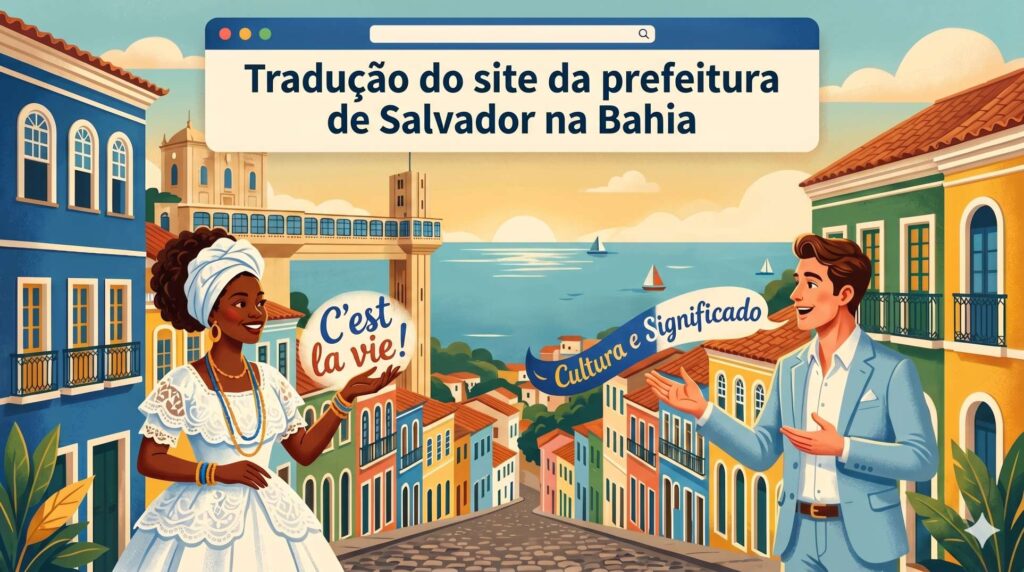
Internationalizing an institutional tourism portal is never just about swapping words from one language to another — and when the destination is one of the most culturally layered cities on the planet, the task becomes something closer to linguistic anthropology. This success story covers how our team handled the French localization of Salvador da Bahia’s official tourism portal, the primary digital gateway the City of Salvador uses to reach European travelers — and how we made sure nothing of Bahia’s character got lost in the process.
Why Salvador Needed a French-Language Portal
Salvador’s tourism portal is the digital face of a city built on history, music and centuries of cultural blending. As the flow of high-end European visitors grew, the City of Salvador recognized that reaching key source markets — France, Belgium, Switzerland, Canada — meant offering the portal in fluent, polished French, not a machine-translated approximation.
That decision wasn’t arbitrary. French-speaking travelers are widely known for their interest in heritage, history and cultural immersion — exactly the kind of audience that notices when a translation feels off. Our agency was brought in specifically to replace earlier automated translation with human expertise, with the explicit goal of making this project a success story the city could point to as a benchmark for digital communication.
The Real Challenge: Culture, Not Grammar
French grammar was never the hard part. The real challenge was the distance between a Parisian reader’s frame of reference and the lived reality of Salvador — the rhythm of an Olodum performance, the presence of the Baianas de Receptivo, an afternoon at Farol da Barra. Many of these concepts simply don’t have equivalents in French, and a literal translation tends to flatten them into something confusing or, worse, meaningless.
Our localization team worked to strike a balance: technically accurate, but written so a French reader could genuinely understand why something matters — and feel drawn to experience it in person rather than just read about it.
Localization in Practice: How Specific Terms Were Handled
To show what this looked like in practice, here’s how we approached three pillars of Salvador’s identity — each term reviewed by an internal linguistic validation committee before going live.
Bahian Cuisine
Food is inseparable from how visitors experience Salvador, and generic French equivalents would have undersold it from the start.
- Acarajé — rather than the flat “beignet de haricots” (bean fritter), we kept the original term and added a sensory description: an Afro-Brazilian culinary specialty made from black-eyed pea batter, deep-fried in palm oil (dendê) and topped with shrimp.
- Dendê oil — precisely described as crude palm oil (dendê), distinguishing it clearly from the refined palm oil familiar to European food shoppers, and signaling its artisanal, cultural value.
- Moqueca — introduced as a traditional fish or seafood stew, slow-cooked in coconut milk and dendê oil — framed in a way that speaks directly to a haute cuisine audience.
Festivals and Historic Sites
Salvador’s major celebrations and landmarks needed context, not just translation, for foreign readers to grasp their scale and significance.
- Lavagem do Bonfim — rendered as the festival of the ritual washing of the steps of the Bonfim Church, with enough context to explain the ecumenical ceremony and the central role of the baianas in the procession.
- Pelourinho — kept as a proper noun, but consistently paired with “the historic quarter of Pelourinho,” immediately evoking its status as a UNESCO World Heritage site.
- Trio Elétrico — we avoided literal (and slightly absurd) translations like “electric truck,” landing instead on a description of a monumental mobile stage on which artists perform during Carnival.
Religion and Movement Arts
Religious syncretism and body-based art forms demanded particular care, both linguistically and ethically.
- Candomblé — described with institutional respect as an ancestral Afro-Brazilian religion of Yoruba origin, deliberately avoiding the dismissive framing that automated tools often default to.
- Capoeira — correctly positioned as an Afro-Brazilian martial art combining dance, music and acrobatics, preserving its dual identity as both a sport and a form of cultural resistance.
The Methodology Behind the Project
A project of this scale needed more than good translators — it needed a system. We structured the work around native-speaking translators, reviewers with specific experience in luxury tourism, and a final quality committee reviewing everything before publication.
To keep hundreds of pages consistent, we built a dedicated translation memory — a database ensuring that the same cultural term is rendered the same way everywhere on the site, no matter which translator touched that particular page. That consistency is what protects the integrity of Salvador’s brand across the entire portal, and it’s a big part of what makes this a genuine success story rather than just a one-off translation job.
Why Human Translation Was the Right Call
For a public agency or major destination brand, relying on free translation tools is a reputational risk that simply isn’t worth taking. A clumsy or inconsistent translation doesn’t just read poorly — it quietly undermines confidence in everything else on the site, including the practical information visitors rely on: opening hours, safety guidance, hotel details, attraction descriptions.
Professional human translation functions as more than a language service — it’s an institutional safeguard. By investing in this level of quality, the City of Salvador positioned its tourism portal alongside those of major European capitals, demonstrating respect for visitors’ culture and language before they’ve even booked a flight.
Conclusion: A Model for Internationalizing Global Destinations
Bringing a digital destination brand into a new language at scale takes more than translation skill — it takes technical rigor, cultural sensitivity, and genuine respect for the place being represented. This project stands as a success story in our own history precisely because it proves that language barriers stop being obstacles once they’re approached with the right expertise and methodology.
By speaking to its French-speaking visitors with fluency and cultural authority, Salvador opens its doors with the prestige the city has always deserved. We’re proud to have built the linguistic foundation connecting the soul of Bahia to audiences across the French-speaking world.
Additional Resources
- Salvador City Hall
- Official Tourism Portal — Salvador, Bahia
- ACB — Bahia Commercial Association
- FIEB — Federation of Industries of the State of Bahia
