
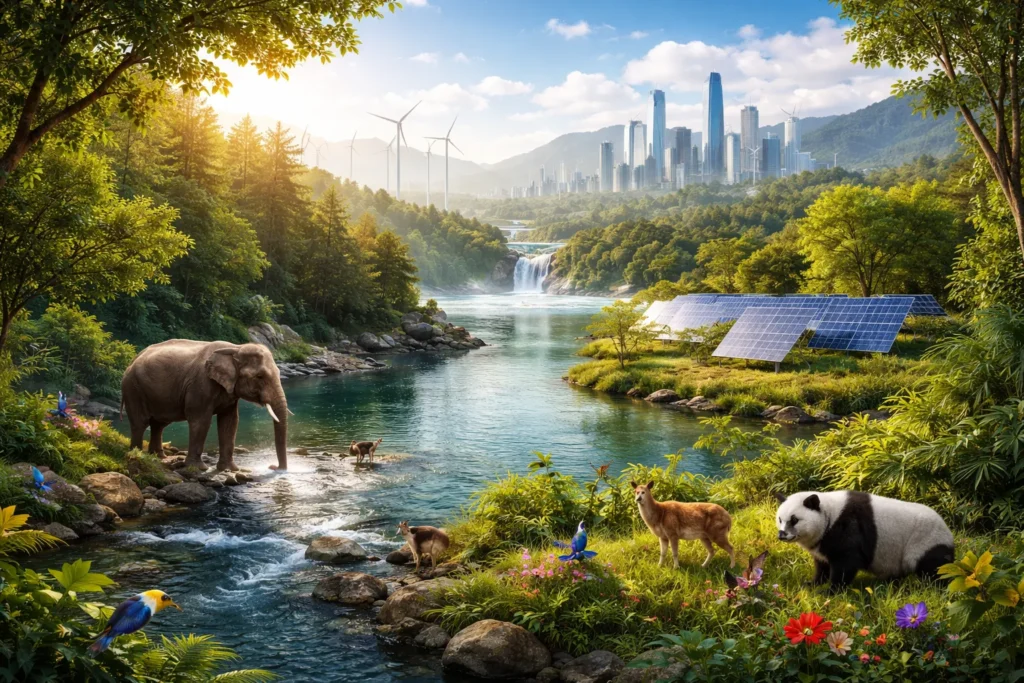
Every June 5, World Environment Day invites the world to pause and reconsider its relationship with the planet. It is a moment for reflection, but also a call to action — a reminder that environmental preservation, decarbonization and sustainable development are not abstract goals but urgent priorities that require coordinated effort across governments, industries and communities. As specialists in multilingual communication working alongside sustainability initiatives, we see firsthand how much international cooperation depends on clear, accurate dialogue between nations that don’t share a language.
What World Environment Day Represents
World Environment Day is not simply a symbolic date on the calendar. It represents decades of growing global awareness about the fragility of the ecosystems that sustain human life. Forests, oceans, wetlands and soil all provide services — clean air, fresh water, climate regulation, food security — that are easy to take for granted until they begin to fail. Environmental degradation carries real costs: more frequent natural disasters, the spread of disease, and growing resource scarcity. Organizations such as UN Environment use World Environment Day each year to refocus attention on these risks and mobilize action before the costs become irreversible.
Green Industries: The Engine of Decarbonization
One of the clearest signs of progress since the first World Environment Day decades ago is the emergence of an entirely new industrial sector built around sustainability. Green industries cover renewable energy, energy efficiency, waste management, the circular economy and sustainable materials. Solar and wind power, electric vehicles and environmental biotechnology are no longer niche experiments — they are mainstream investment categories creating jobs and reshaping entire economies. Technological innovation continues to lower costs and expand access, making the transition to a low-carbon economy increasingly viable for countries at every stage of development.
China’s Role in the Decarbonization Story
Few examples illustrate the scale of this shift better than China. As the world’s largest industrial economy, China faces environmental pressures that few other nations encounter at the same scale — yet it has also become a leading investor in renewable energy, particularly solar and wind capacity. Alongside rapid growth in electric vehicles and public transportation, China has tightened policies on air and water pollution and committed to carbon neutrality by 2060. This trajectory — industrial scale paired with an accelerating environmental agenda — is precisely the kind of transformation that World Environment Day was created to encourage globally.
Global Investment in Climate Action
The scale of investment required to address climate change is reflected in the commitments major economies have made toward renewable energy and environmental protection:
| Country | Renewable Energy Investment (USD Billions, 2022) | Environmental Protection Investment (USD Billions, est.) | Carbon Neutrality Target |
|---|---|---|---|
| China | 266.0 | 110.0 | 2060 |
| United States | 141.0 | 50.0 | 2050 |
| European Union | 100.0 | 70.0 | 2050 |
| India | 30.0 | 15.0 | 2070 |
| Japan | 25.0 | 20.0 | 2050 |
Note: figures are approximate, based on 2022 reporting and estimates; carbon neutrality targets may be revised.
Why Interpreters Are Essential to Environmental Diplomacy
The conversations that turn climate commitments into binding agreements happen at conferences like the UNFCCC Conference of the Parties (COP), where representatives from nearly 200 countries negotiate side by side. With that many languages in the room, the margin for misunderstanding is enormous — and the stakes are too high to leave to chance. Professional interpreters do far more than convert words from one language to another. They carry tone, intent and cultural context across the gap, ensuring that a proposal understood one way by its author isn’t misread by the delegation receiving it.
This is the quieter side of World Environment Day: behind every joint declaration and emissions target is a chain of interpreters and translators who made sure nothing was lost between the negotiating table and the final text. Without that layer of communication, even the most ambitious environmental policy risks falling apart in translation — literally.
Frequently Asked Questions
What is the origin of World Environment Day? The United Nations General Assembly established World Environment Day in 1972, during the Stockholm Conference on the Human Environment. June 5 marks the opening day of that conference and has been observed globally ever since.
What are the main goals of World Environment Day? The day aims to raise awareness of pressing environmental issues — pollution, deforestation, climate change and biodiversity loss — while encouraging both policy action and individual responsibility toward sustainable development.
How can individuals contribute on World Environment Day and beyond? Practical steps include reducing consumption, reusing and recycling materials, conserving water and energy, choosing sustainable transport, cutting back on single-use plastics, and supporting businesses with credible environmental practices. Small actions, repeated by millions, add up to measurable impact.
Which industries offer the most opportunity in the environmental sector? Renewable energy (solar, wind, green hydrogen), energy efficiency, waste management, the circular economy, electric mobility, sustainable agriculture, carbon capture and nature-based solutions are among the fastest-growing fields, with rising demand for skilled professionals.
Why does COP matter for the future of the planet? COP conferences are the primary international forums for negotiating climate action — setting targets, reviewing progress, and coordinating financing and policy across nearly 200 nations. They remain central to global climate governance.
Conclusion: Communication as a Climate Tool
World Environment Day is a reminder that the planet’s challenges are shared ones, and shared challenges require shared understanding. The shift toward green industries and decarbonization — visible in economies as different as China, the EU and India — shows that environmental responsibility and industrial growth are not mutually exclusive. But none of that progress happens in isolation. It happens through negotiation, agreement and cooperation across language barriers, supported by the professionals who make that cooperation possible. This World Environment Day, the call to action extends beyond personal habits — it’s also a recognition that clear communication is, itself, a climate solution.
