
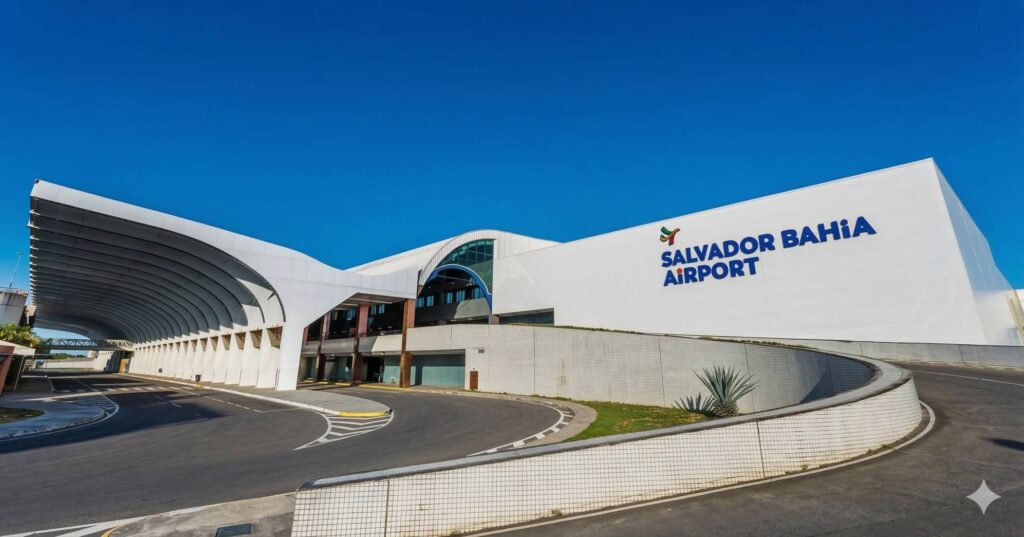
Few projects test a language services team like the handover of an international airport. When VINCI Airports took over the concession for Salvador Bahia Airport in 2017, the transition involved far more than signing paperwork — it meant transplanting an entire operational culture from France onto Brazilian soil, system by system and department by department. Our team worked at the center of that process, moving fluidly between French, English and Portuguese to make sure nothing got lost along the way.
Who Is VINCI Airports?
Understanding the scale of this project starts with understanding the client. VINCI Airports is the world’s leading private airport operator, part of the France-headquartered VINCI Group, a major global player in concessions and construction. Taking over an airport like Salvador’s wasn’t just an acquisition — it was, in effect, an export of an entire management philosophy: rigorous processes, sustainability targets, and a particular way of running technology and operations that had been refined across VINCI’s global airport network. Our role was to make sure that philosophy arrived intact.
The 2017–2018 Transition: Two Fronts at Once
The concession auction took place in March 2017, kicking off a transition from a state-run operation to a high-performance private model. From day one, our technical interpretation and translation team was working two parallel tracks:
- The technology front — installing proprietary hardware and software systems
- The administrative front — understanding how the airport’s offices actually worked, from HR to finance to day-to-day management culture
Both tracks ran simultaneously, and both depended on language support that could keep pace with engineers, executives and local staff all at once.
Technical Interpretation: Installing VINCI’s Proprietary Systems
VINCI Airports relies on global monitoring, security and passenger-flow systems developed and maintained largely by French engineering teams — but the working language of aviation IT is English. That meant our interpreters were often the only link between French systems engineers and the English-speaking technical specialists overseeing installation, translating in real time as configurations, protocols and troubleshooting steps were worked through.
The documentation side was just as demanding. Our team translated and reviewed protocols covering:
- Air traffic management systems, where a single mistranslated term carries national security implications
- Ground logistics software, ensuring local staff fully understood the efficiency benchmarks the new French management brought with them
- Cybersecurity protocols, aligned with international data protection and infrastructure standards
Beyond the Machinery: Office Culture and Administrative Onboarding
It’s a common mistake to treat an airport transition as purely a technology project. VINCI Airports took a broader view — understanding that long-term success depended on how well the new management understood the existing office, not just the existing infrastructure.
Our team spent weeks embedded in Salvador’s executive and administrative departments, helping the incoming French leadership make sense of:
- HR processes and Brazilian labor law — translating the practical realities of local hiring and employment practices
- Financial and accounting workflows — critical for folding the airport’s numbers into the parent company’s global reporting in France
- Organizational culture — acting as cultural mediators between a French management style built on clear hierarchy and rigorous process, and a Bahian team that needed to feel engaged rather than simply instructed
A Trilingual Working Environment: French, English and Portuguese
One of the more unusual aspects of this project was its language mix. VINCI Airports is a French company, but aviation runs on English — and Salvador’s day-to-day operations run in Portuguese. Board meetings sometimes moved between all three languages within minutes: French for parent-company matters, English for technical and IT discussions, Portuguese for local operations.
Holding that trilingual thread together — without losing technical precision in any direction — was essential to keeping the technology rollout on schedule. This is simultaneous interpretation in its most demanding form: not just two languages, but three, often within the same conversation.
Why Terminology Accuracy Matters in Aviation
In an airport environment, translation errors aren’t just embarrassing — they can have regulatory consequences with bodies like ANAC, Brazil’s National Civil Aviation Agency. During the VINCI Airports transition, our work covered the integrity of:
- Standard Operating Procedure (SOP) manuals
- Concession contracts and legal addenda
- Environmental and infrastructure audit reports
Every one of these document types required not just linguistic accuracy, but an understanding of the regulatory and operational context behind the words.
Linguistic Diplomacy: The Strategic Layer
Beyond documents and systems, there was a quieter but equally important role: helping the incoming French team understand what was happening around them — reading the tone of a meeting, the subtext of a concern raised by local staff, the cultural signals that don’t translate literally. We call this linguistic diplomacy. It’s not about converting words; it’s about building trust between two organizations navigating a period of real uncertainty, which any ownership transition inevitably brings.
The Results: Salvador Bahia Airport Under VINCI
The outcome speaks for itself. Under VINCI Airports’ management, Salvador Bahia Airport has become one of the most efficient operations in VINCI’s global network, repeatedly recognized as Brazil’s Most Sustainable Airport. Language support was never the headline — it was the mechanism that let everything else move forward without friction. That synergy translated into measurable outcomes:
- Technology migration without delays — VINCI’s proprietary systems went live on schedule, with no disruption to passenger services
- Fast cultural and administrative integration — local staff absorbed the new operational standards quickly, with clear lines of communication between Salvador and headquarters in France
- Alignment with VINCI’s global vision — the executive team’s focus on innovation and sustainability reached the full workforce, setting a new benchmark for airports across Brazil’s Northeast
Why Choose Us for International Transitions
The VINCI Airports case at Salvador demonstrates the kind of work we’re built for:
- Online and in-person services — supporting clients anywhere in Brazil or abroad
- Specialized human expertise — critical engineering and management terminology isn’t something we leave to automated tools
- Infrastructure fluency — comfortable across aviation, IT and corporate management language, often in the same meeting
Frequently Asked Questions
What’s the difference between interpretation and technical translation in a project like this? Interpretation happens in real time — in meetings, on the floor, during installations. Technical translation covers the written side: documentation, manuals and software interfaces that need to be accurate and consistent over time.
How is confidentiality handled in infrastructure projects like the VINCI Airports transition? All work is governed by strict Non-Disclosure Agreements (NDAs). Strategic information about operations, systems and contracts is handled with the same security standards the client itself requires.
Do you support other companies in the transportation sector? Yes. The same approach used for VINCI Airports — combining technical translation, real-time interpretation and cultural mediation — applies equally to ports, railways and major logistics hubs operating across multiple languages.
Conclusion
The VINCI Airports transition at Salvador Bahia Airport is a clear example of what’s at stake when a global operator takes over critical infrastructure in a new country: it’s not just about installing systems, it’s about making sure people — engineers, managers, frontline staff — genuinely understand each other through that change. If your organization is navigating a similar transition across languages and cultures, get in touch — we’d be glad to discuss how our experience can support your project.
