Indian Language Interpretation Across the UK
India and the United Kingdom share one of the most significant people-to-people, commercial, and diplomatic relationships in the world. The UK and India have a strong people-to-people link through the 1.9 million Indian diaspora in the UK — what Indian Prime Minister Narendra Modi calls the “living bridge” — alongside a thriving bilateral trade relationship worth £47.2 billion. business
For the sixth consecutive year, India remains the UK’s second-largest investor, trailing only the United States in both new projects and number of jobs created in 2024/25, with over 1,000 Indian-owned companies now operating across the UK. India and the UK signed the Comprehensive Economic and Trade Agreement (CETA) in July 2025 — marking a major milestone in bilateral economic relations and creating new opportunities for trade, investment, and employment. businessIBEF
The South Asian community — encompassing 1,927,150 British Indians, 1,662,286 British Pakistanis, and 651,834 British Bangladeshis — collectively represents the largest non-English speaking population group in the United Kingdom. The Indian subcontinent’s linguistic diversity is reflected across UK cities, NHS trusts, courts, and public services — making Indian language interpretation one of the most significant and consistently demanded professional services in British public life. Wikipedia
Talk and Chalk provides professional, certified interpretation across all major Indian subcontinent languages — including Punjabi, Urdu, Gujarati, Hindi, Bengali, and Tamil — serving legal institutions, NHS trusts, local authorities, corporate organisations, and government departments across England, Scotland, Wales, and Northern Ireland.
The Major Indian Languages in the UK
Punjabi — The UK’s Largest Indian Language Community
There are approximately 273,000 native Punjabi speakers in the UK — making the UK home to the largest Punjabi diaspora in the world. Many Punjabi immigrants have settled in the Southall area of Greater London, which has been nicknamed “Little Punjab”. The British Punjabi community — predominantly Sikh — is also heavily concentrated in Birmingham, Leicester, Leeds, Wolverhampton, and Coventry. Absolute-interpreting
Punjabi interpretation is required across HMCTS court proceedings, NHS healthcare consultations, UKVI immigration proceedings, and local authority services. The British Sikh community’s significant presence in UK public life — including in Parliament, the legal profession, and the NHS — makes Punjabi one of the most strategically important Indian languages for professional interpretation in the UK.
Key Punjabi interpretation settings:
- HMCTS Crown Court, magistrates’ court, and family court proceedings
- NHS consultations at NHS trusts serving Southall, Birmingham, and Leicester — where Punjabi is one of the most requested languages
- UKVI immigration appointments and First-tier Immigration Tribunal appeals
- Local authority social services and DWP benefit assessments
- UK-India corporate meetings for Punjabi-speaking business owners and executives
Urdu — Serving the UK’s Pakistani and Indian Muslim Communities
Approximately 269,000 to 400,000 people in the UK speak Urdu — serving both the Pakistani community and the significant Muslim population of Indian origin across the UK. Urdu is the national language of Pakistan and is widely spoken and understood across the British Pakistani community — concentrated in London, Birmingham, Bradford, Manchester, Kirklees, Luton, Slough, and Oldham. Absolute-interpretingWikipedia
Urdu interpretation is one of the most frequently requested languages in HMCTS courts and NHS trusts across the UK — particularly in West Yorkshire, Greater Manchester, the West Midlands, and East London — where the British Pakistani and Indian Muslim communities are most concentrated.
Key Urdu interpretation settings:
- HMCTS criminal, family, and civil court proceedings in Bradford, Birmingham, Manchester, and London
- NHS maternity services, mental health consultations, and GP appointments across West Yorkshire and West Midlands NHS trusts
- UKVI immigration interviews and asylum proceedings
- DWP benefit assessments and local authority social services
- Employment tribunal proceedings for Urdu-speaking workers
Gujarati — The UK’s Leading Indian Business Language
Gujarati is spoken by approximately 250,000 people in the UK — predominantly from the British Indian Hindu and Jain communities with roots in Gujarat, East Africa (Kenya, Uganda, Tanzania), and the wider Gujarati diaspora. The British Gujarati community is heavily concentrated in Leicester, Harrow, Wembley, Brent, and Barnet — and is one of the most economically active communities in the UK, with significant representation in retail, manufacturing, pharmaceuticals, and financial services.
Key Gujarati interpretation settings:
- HMCTS court proceedings and commercial litigation for Gujarati-speaking business owners
- NHS consultations across Leicester, Harrow, and Wembley NHS trusts — where Gujarati is one of the most requested Indian languages
- FCA-regulated financial services compliance meetings for Gujarati-speaking entrepreneurs and investors
- Local authority services and DWP assessments
- UK-India CETA trade negotiations and corporate governance for Gujarati-owned UK businesses
Hindi — Growing Professional and Student Community
Hindi is the most widely spoken language in India and is increasingly significant in the UK — serving a growing community of Indian professionals, IT specialists, NHS healthcare workers, students, and corporate executives. With over 1,000 Indian-owned companies operating across the UK and Indian FDI projects creating over 6,000 new jobs in 2024/25 — professional Hindi interpretation is essential for board-level governance, FCA compliance reviews, and corporate communications connecting UK and Indian executive teams. business
Key Hindi interpretation settings:
- Board meetings and M&A negotiations for Indian corporations operating in the UK — including Tata Group UK, Infosys UK, Wipro UK, and HCL Technologies UK
- FCA-regulated compliance meetings for HDFC Bank UK, Axis Bank UK, and ICICI Bank UK
- HMCTS court proceedings and UKVI immigration appointments
- NHS medical consultations for Hindi-speaking patients and healthcare staff
- LCIA international arbitration proceedings involving Indian parties
Bengali and Sylheti — Serving the UK’s Bangladeshi Community
Bengali — and its widely spoken Sylheti dialect — is one of the most frequently requested languages across NHS trusts serving East London, where the Bangladeshi community of 651,834 is most concentrated. Tower Hamlets, Newham, Camden, and Hackney host the largest Bangladeshi communities in the UK — generating significant and consistent demand for professional Bengali interpretation across legal, healthcare, and public service settings. Wikipedia
Key Bengali/Sylheti interpretation settings:
- HMCTS Crown Court and family court proceedings — Bengali is one of the most requested languages at East London courts
- NHS consultations at Barts Health NHS Trust and East London NHS Foundation Trust — where Bengali/Sylheti is among the most requested interpretation languages
- UKVI asylum interviews and immigration proceedings
- Local authority social services in Tower Hamlets, Newham, and Camden
- DWP benefit assessments and housing proceedings
Note on dialect: Sylheti is a distinct dialect of Bengali spoken by the majority of British Bangladeshis — differing significantly from Standard Bengali in vocabulary, phonology, and grammar. Our interpreters are proficient in both Standard Bengali and Sylheti — ensuring that Bangladeshi community members receive culturally appropriate and linguistically precise interpretation.
Tamil — Serving the Sri Lankan and South Indian Communities
Tamil is spoken by a significant community in the UK — encompassing both Tamil-speaking British Indians from Tamil Nadu and the substantial Sri Lankan Tamil diaspora who arrived as refugees following Sri Lanka’s civil conflict. The British Tamil community is concentrated in North London — particularly in Wembley, Harrow, Ilford, and East Ham — as well as in Birmingham and Manchester.
Key Tamil interpretation settings:
- HMCTS court proceedings for Tamil-speaking defendants, witnesses, and asylum applicants
- UKVI asylum interviews and First-tier Immigration Tribunal appeals — Tamil is a significant asylum-seeker language given the Sri Lankan Tamil diaspora
- NHS medical consultations across North London and Birmingham NHS trusts
- Local authority social services for Tamil-speaking families
- UK-India technology and IT sector corporate meetings for Tamil-speaking Indian professionals
UK-India Trade and Corporate Interpretation
India and the UK signed the Comprehensive Economic and Trade Agreement (CETA) in July 2025 — projected to unlock a US$23 billion trade corridor by eliminating tariffs on a broad basket of products. Bilateral trade is projected to increase by around £25–26 billion annually by 2040, with key sectors including textiles, engineering goods, gems and jewellery, IT services, and pharmaceuticals. IBEFVajiram and Ravi
Major Indian corporations with significant UK operations requiring professional Indian language interpretation include:
- Tata Group UK — encompassing Jaguar Land Rover, Tata Steel UK, and Tata Consultancy Services UK
- Infosys UK, Wipro UK, and HCL Technologies UK — India’s leading IT services companies
- HDFC Bank UK, Axis Bank UK, ICICI Bank UK, and State Bank of India UK — Indian financial institutions in the City of London
- Sun Pharmaceutical UK, Dr. Reddy’s UK, and Cipla UK — Indian pharmaceutical companies with MHRA-regulated UK operations
- Mahindra UK and Bajaj Auto UK — Indian automotive and technology companies
Legal Proceedings and Access to Justice
South Asian languages collectively represent the most significant group of non-English languages in HMCTS courts across the United Kingdom. NRPSI-registered interpreters in Punjabi, Urdu, Gujarati, Hindi, Bengali, and Tamil are required for:
- Crown Court criminal defence proceedings and magistrates’ court hearings
- Family court proceedings involving South Asian-speaking parents and children
- Employment tribunal hearings for South Asian workers
- UKVI asylum interviews and First-tier Immigration Tribunal appeals
- Home Office modern slavery investigations — South Asian nationals, particularly from India and Bangladesh, are among the most significant groups referred to the National Referral Mechanism (NRM)
- Police interviews under PACE and solicitor consultations
- LCIA international arbitration involving Indian corporate parties
NHS Healthcare and Patient Safety
South Asian languages are among the most frequently requested interpretation languages across NHS trusts throughout the United Kingdom — particularly in London, the West Midlands, West Yorkshire, and the East Midlands. The Care Quality Commission (CQC) requires NHS providers to ensure effective communication with all patients — making professional Indian language interpretation an essential component of safe, equitable, and CQC-compliant healthcare delivery.
High-demand NHS interpretation settings for Indian languages include:
- Maternity services — South Asian women have specific cultural and linguistic needs in maternity settings, and professional interpretation is essential for safe birth outcomes and informed consent
- Mental health services — The British South Asian community faces significant mental health challenges, often compounded by language barriers and cultural stigma around mental health
- Diabetes and cardiovascular care — South Asian communities have significantly higher rates of Type 2 diabetes and cardiovascular disease, generating high demand for specialist medical interpretation
- Elderly care — First-generation South Asian elderly residents often have limited English proficiency, requiring certified interpretation for all NHS interactions
Our Indian Language Interpretation Solutions
Consecutive Interpretation for Legal and Medical Settings
- Application: HMCTS court hearings, UKVI immigration interviews, NHS medical consultations, police interviews, and solicitor consultations — in Punjabi, Urdu, Gujarati, Hindi, Bengali/Sylheti, and Tamil
- Advantage: Legal precision and full NRPSI and DPSI compliance — protecting the legal rights of South Asian-speaking parties throughout UK proceedings
Simultaneous Interpretation for Corporate and Trade Events
- Application: UK-India Business Council (UKIBC) events, UK-India CETA trade forums, Tata Group and Infosys corporate conferences, and large-scale bilateral trade events
- Advantage: Real-time fluency ensuring Indian and British executives, engineers, and officials communicate without interruption
Community and Public Service Interpretation
- Application: Local authority social services, DWP benefit interviews, housing proceedings, SEND assessments, and child protection conferences
- Advantage: Certified, impartial interpreters ensuring full access to UK public services for all South Asian communities
Remote Indian Language Interpretation (RSI)
- Application: Virtual legal hearings, NHS video consultations, UK-India corporate board meetings, and public service appointments
- Advantage: Immediate, flexible access to certified interpreters in all major Indian languages — for urgent legal, medical, and commercial requirements across the UK
Key Areas of Operation Across the UK
London — Supporting South Asian communities across HMCTS courts in Southall, Tower Hamlets, Wembley, and Harrow; NHS trusts serving the capital’s diverse South Asian population; UKVI proceedings; and Indian corporate clients at the UK-India Business Council, High Commission of India London, and City of London financial institutions.
Leicester — Supporting one of the UK’s largest South Asian communities — particularly Gujarati and Punjabi-speaking residents — across University Hospitals of Leicester NHS Trust, HMCTS proceedings, and Leicester City Council public services.
Birmingham and the West Midlands — Supporting Punjabi, Urdu, and Gujarati-speaking communities across University Hospitals Birmingham NHS Foundation Trust, Birmingham Crown Court, Sandwell and West Birmingham NHS Trust, and local authority services.
Bradford, Leeds, and West Yorkshire — Supporting the large Urdu and Punjabi-speaking communities across Bradford Teaching Hospitals NHS Foundation Trust, Leeds Teaching Hospitals NHS Trust, and HMCTS proceedings across West Yorkshire.
Manchester and the North West — Supporting South Asian communities across Manchester University NHS Foundation Trust, HMCTS proceedings, and local authority services across Greater Manchester.
Edinburgh and Scotland — Supporting South Asian communities across NHS Scotland trusts, Scottish Courts and Tribunals Service proceedings, and Scottish Enterprise India trade missions.
Frequently Asked Questions
Which Indian language is most commonly required for UK court proceedings? Punjabi and Urdu are the most frequently requested Indian subcontinent languages in HMCTS courts — reflecting the size and geographic distribution of the British Punjabi Sikh and British Pakistani communities. Bengali/Sylheti is most requested in East London courts, and Gujarati in courts serving Leicester and Harrow.
Do you provide interpretation in Sylheti as well as Standard Bengali? Yes. Sylheti is a distinct dialect spoken by the majority of British Bangladeshis — and differs significantly from Standard Bengali in vocabulary and phonology. We match interpreters to clients based on their specific language variant and regional background — ensuring accurate, culturally appropriate communication in all legal and medical settings.
Can you support UK-India corporate meetings and CETA trade negotiations? Yes. Our specialist interpreters support FCA-regulated board meetings, M&A due diligence, LCIA arbitration, UK-India Business Council events, and corporate governance meetings for major Indian corporations including Tata Group, Infosys, Wipro, and Indian financial institutions operating in the City of London.
Is certified interpretation legally required for South Asian-speaking defendants in UK courts? Yes. Under UK criminal procedure law and Article 6 of the European Convention on Human Rights, every defendant has the right to understand proceedings in their own language. HMCTS requires NRPSI-registered interpreters for all South Asian-speaking parties — making certified professional interpretation a fundamental legal requirement.
Can you provide Indian language interpretation remotely? Yes. We provide remote simultaneous and consecutive interpretation in all major Indian languages — for virtual legal hearings, NHS video consultations, UK-India corporate board meetings, and public service appointments across the UK.
Why Choose Talk and Chalk for Indian Language Interpretation in the UK?
- Comprehensive Language Coverage — Certified interpreters in Punjabi, Urdu, Gujarati, Hindi, Bengali/Sylheti, Tamil, and other Indian subcontinent languages
- Legal Compliance — NRPSI-registered and DPSI-qualified interpreters for UK courts, immigration, and public service settings
- Medical Excellence — Specialist interpreters for NHS maternity, mental health, diabetes, cardiovascular, and elderly care settings across the UK
- Community Authority — Deep knowledge of the British South Asian communities’ cultural context, dialect diversity, and geographic distribution across the UK
- Corporate Capability — Professional interpretation for UK-India CETA trade, Tata Group, Infosys, Indian banking, and UK-India Business Council events
- Institutional Connections — Experience supporting the High Commission of India London, UK-India Business Council, and major Indian financial institutions
- Nationwide Coverage — Professional South Asian language interpreters in person across London, Leicester, Birmingham, Bradford, Manchester, Edinburgh, and throughout the UK
- Remote Capability — Immediate, secure remote interpretation for urgent legal, medical, and commercial requirements
Our Interpretation Services
Simultaneous Interpretation Real-time interpretation for trade forums, corporate conferences, and large-scale events across the UK.
Consecutive Interpretation Precision interpretation for court hearings, NHS consultations, immigration proceedings, and employment tribunals.
Remote Interpretation (RSI) Secure, high-quality interpretation via online platforms for virtual legal hearings and NHS consultations.
Escort Interpreting Flexible, mobile interpretation for site visits, public service appointments, and corporate activities across the UK.
Strategic Presence: Where We Provide Indian Language Interpretation in the UK
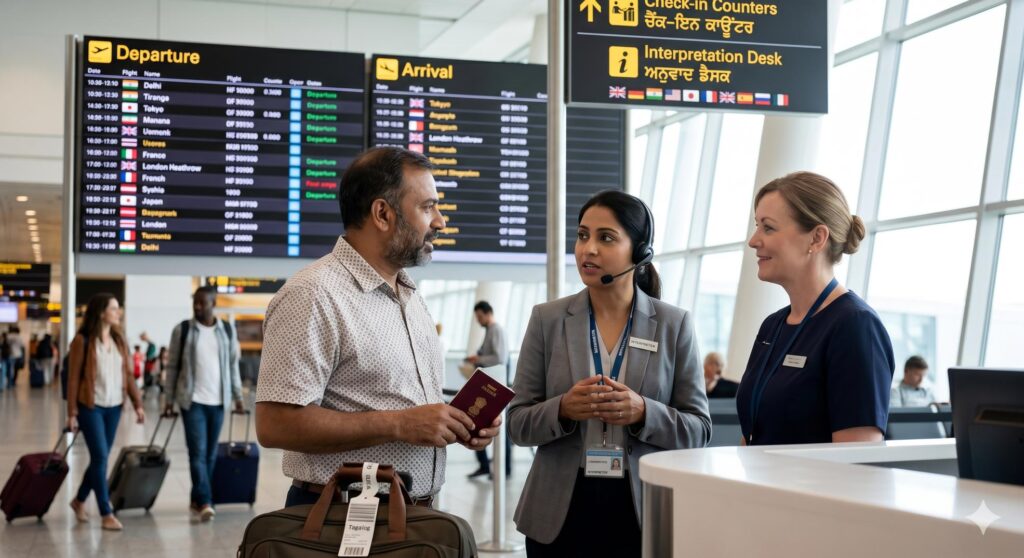
Punjabi interpreter in Wolverhampton
Securing a qualified Punjabi interpreter in Wolverhampton is paramount for effective communication across vital sectors, including legal proceedings, healthcare, and business. Wolverhampton, a city with a rich multicultural heritage, benefits significantly from professional language services that bridge linguistic divides, ensuring…
Punjabi interpreter in Birmingham
Securing a qualified Punjabi interpreter in Birmingham is paramount for effective communication across diverse sectors, from legal proceedings and healthcare consultations to business negotiations and public services. Birmingham, a vibrant and multicultural hub in the West Midlands, relies heavily on…
Punjabi interpreter in Leeds
Securing a qualified Punjabi interpreter in Leeds is paramount for effective communication across vital sectors, from legal proceedings and healthcare to business and immigration. Leeds, a vibrant economic hub in West Yorkshire, relies heavily on its diverse population, making professional…
Punjabi interpreter in Leicester
Securing a qualified Punjabi interpreter in Leicester is paramount for effective communication across vital sectors, including legal, healthcare, and business. Leicester, a city renowned for its vibrant multicultural community, relies heavily on professional language services to bridge communication gaps and…
Punjabi interpreter in Coventry
Securing a qualified Punjabi interpreter in Coventry is paramount for effective communication across vital sectors, including legal, healthcare, and business. In a city as diverse as Coventry, where a significant portion of the population speaks Punjabi, the need for professional,…
Punjabi interpreter in Sheffield
Securing a qualified Punjabi interpreter in Sheffield is paramount for effective communication across a multitude of critical sectors, from legal proceedings and healthcare access to business negotiations and public services. Sheffield, a city with a rich industrial heritage and a…
Punjabi interpreter in Huddersfield
Securing a qualified Punjabi interpreter in Huddersfield is paramount for effective communication across diverse sectors, from legal proceedings to critical healthcare interactions. In a vibrant West Yorkshire town like Huddersfield, where a significant Punjabi-speaking population contributes to its rich cultural…
Punjabi interpreter in Bradford
Securing a qualified Punjabi interpreter in Bradford is paramount for effective communication across vital sectors within the UK’s professional landscape. Whether engaging with the Bradford Teaching Hospitals NHS Foundation Trust for critical healthcare needs or the Bradford District Care NHS…
Types of interpretation

I thoroughly enjoyed my studies. Although my progress was too slow for my liking, the individual lessons helped me develop automaticity in speaking, expand my vocabulary, and improve my reading skills. Listening comprehension remains the most challenging aspect. Thank you.
Alain
Talk.fr Talk.br Talk.com Talk.uk
Our latest posts

bauma CHINA 2026 in Shanghai: A Guide for UK Businesses

Which Countries Hold the World’s Mineral Wealth?

Interpreter Qualifications in the UK: Diplomas, Registers and Requirements

Chinese and Japanese Technical Interpreting at DENSO Brazil

UK Trade Deals Interpreting Demand: Navigating New Opportunities with India and Switzerland

Canton Fair 2026: The Definitive Guide for Brazilian Buyers
Interpreting Services Terms and Conditions in the UK